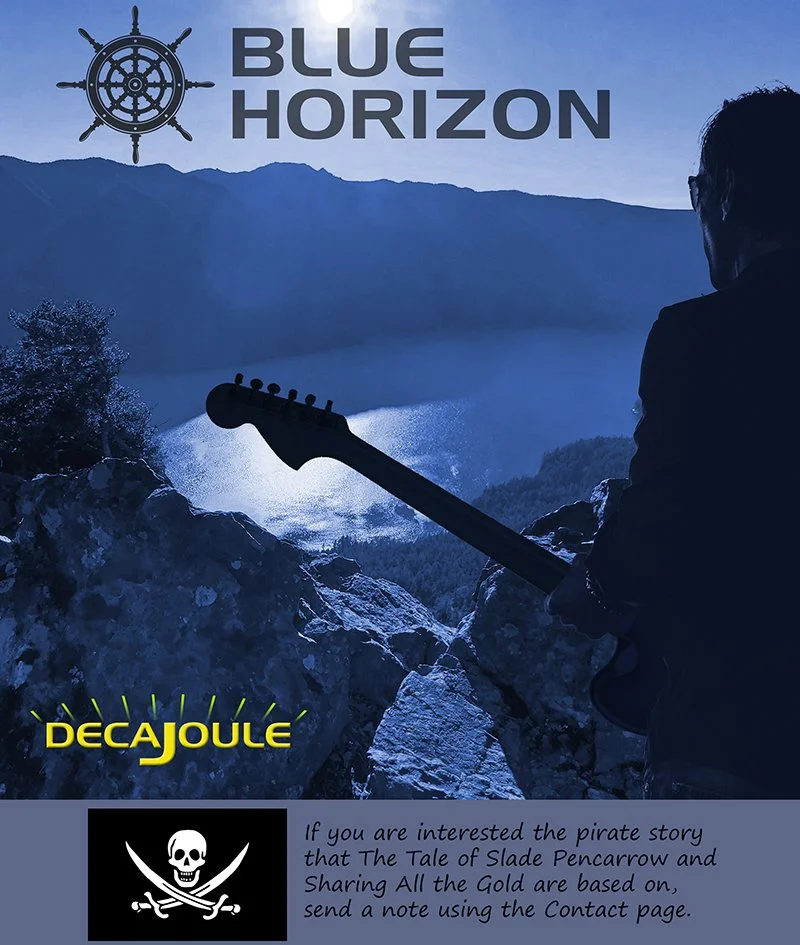
BLUE HORIZON
John Eric Klemesrud wrote all the music and lyrics, and performed on all the instruments except where stated otherwise. This includes guitars, keyboards/drums, bass on most songs, mandolin on Sharing All the Gold, plus background vocals on Intangible Frontier, Captain Aeolus, Whiskey Bend, and Ethereal Elevations. Significant contributions came from Greg Van Kerkhof of South Africa who sang on Tree Canopy, Raven Stole the Sun, and Whiskey Bend. Greg also played bass on The Tale of Slade Pencarrow, Intangible Frontier, and Raven Stole the Sun.
Vocalists and musicians hired on Fiverr for this album come from Argentina, Colorado, Finland, India, Israel, Los Angeles, Nigeria, Romania, South Africa, Spain, Texas, Thailand, Turkey, the UK, and the Ukraine. Some of these artists have impressive resumes with TV appearances and awards. See the individual songs below for details.
The photo for the album cover was taken from Pyramid Peak on the Olympic Peninsula.
PRODUCER: John Eric Klemesrud
RELEASE: 08/15/2025
-
Sometimes you just need to get away for a while, be inspired by nature, and recharge. It can do wonders for your mental health. The verse and chorus were written first on the guitar. The bridge was added later. The instrumental parts with lead guitar feel like a chorus even though they’re not. It was fun to add a horn section after being a Chicago fan for many years. It consists of three types of saxophones and a trumpet provided by Dima Faustov of the Ukraine. Lead vocals are performed by Katie Burke of Los Angeles. Christopher Galen of Colorado performs most of the other vocals with Viktoria Sunshine of Romania joining in near the end.
-
Originally, the verse progression was inspired by Fooling Yourself (Styx). The chorus progression is unique. I haven’t been able to find another song with it. It was written on acoustic guitar and converted to this reggae rock style. The electric guitar sound was inspired my Nile Rodgers of Chic and the work he did on Let’s Dance (David Bowie). An earlier version of the song was on a Mira Costa College CD called Watering the Wasteland. The lyrics are about how when we travel through life, it’s best to not neglect the important mental and emotional journeys that are always happening regardless of our coordinates on the map. The bass is performed by Greg Van Kerkhof of South Africa. Lead vocals are by Marc Kooel of Spain (verses) and Amin Yahyazadeh of Turkey (choruses). Amin won The Voice Persia in 2023.
-
Experimenting with dissonance in the sustain of hammered dulcimer notes, I realized that the E(add#5) at the start has the same notes as a Ammaj7 except for the bass. The D6 / Dm6 part was also a cool discovery. The lyrics expanded on a pirate story developed from family history research and the true history about Hender Molesworth being the governor of Jamaica and his dealings with notorious pirate Joseph Bannister. Now the song provides a window into a more complete story. I wrote a two-page treatment (detailed summary) and only small adjustments to the lyrics were needed to keep the song in sync with the full tale. The bass guitar was performed by Greg Van Kerkhof of South Africa. Nicolas Sokolic of Argentina is on mandolin and Peter Voronov of Turkey is on violin. I included a deep bass singer (Thomas Hoffmann of Brazil) for part of the chorus background vocals after being inspired by the Bass Singers’ version of Hoist the Colours by Hans Zimmer. The first time I heard this version I happened to be sailing on a replica Viking ship near Bergen, Norway. Lead vocals are by Nick Russ of the UK and Christopher Galen of Colorado.
-
The intro and the second instrumental section were an instrumental piece by themselves. The rest was an older version of the song. Seems the two pieces were meant for each other. The song format is unorthodox with no chorus. The three verses have what I think of as a pre-verse introductory line. There’s a descant (counter-melody) during the verses. The descant could be considered like a chorus. It just happens to be simultaneous with the verses. The time signatures also make it unique as some parts shift from 4/4 to 3/4 or 6/4. The lyrics are inspired by my experience walking under an old-growth tree canopy. It gives me a sense of peace and is especially beautiful when the sun is low and the sunbeams go through the trees. The last verse was inspired by TS Eliot: “… and the end of all our exploring will be to arrive where we started and know the place for the first time.” Guitar was performed by Vladimir Gapontsev of Thailand who is a prize winner of many international competitions. Mandolin was performed by Nicolas Sokolic of Argentina. The ney was played by Ido Romano of Israel. Vocalists are Viktoria Sunshine of Romania and Greg Van Kerkhof of South Africa.
-
This is the traditional story from the mythology of the Pacific Northwest coastal tribes. My lyrics roughly follow the Tlingit version. Recorded raven calls, which are amazingly varied, have been added into the music. Some inspiration is from Native American styles and Jethro Tull. The dynamic flute sound is a ney performed by Ido Romano of Israel. The intro, which also occurs before the final chorus, has a climbing bass to fit the idea of lifting into the sky. The verse has gone through style changes. First, it was a bluesy rock rhythm guitar, then acoustic fingerpicking. After creating a cooler bass part, inspiration came for a cleaner electric guitar part that didn’t follow the same pattern as the bass but complimented it. I think the key changes and style changes help to make it more musically interesting. Lead vocals are by Christina Rotondo of the UK who has also performed lead vocals on a song in a Doctor Who episode. Greg Van Kerkhof of South Africa provides background vocals and performs on bass.
-
The ending of The Tale of Slade Pencarrow has a sea shanty vibe. I had the idea to reuse that part and make it part of a sea shanty. It became more than that as the verses are like a dirge, slower and dark. Some inspiration for the chorus came from Blow the Man Down in that it has a repeating refrain after each line. Sharing All the Gold has that format in a set chorus, but then the third and fourth choruses have changing lines prior to each repeating refrain which make it more like the Blow the Man Down format. The instrumental segments are like those in The Tale of Slade Pencarrow, but the mandolin and violin switch parts. This is like when a movie theme repeats at certain times during the story. The ending also has repeating themes with the final melody being the theme for Slade Pencarrow. The lyrics expand on the idea of Pencarrow being a hero. I like how tonal shifts at the end of the verses enhance the idea of hope as the key goes from F minor to F major. Ending up in F major works perfectly as the instrumental key, D minor, is the relative minor key. Just before the Pencarrow signature melody ending there’s a segment that comes from The Tale of Slade Pencarrow bridge. It has tonal shifts as well and gives the ending kind of a cinematic feel as intended. Each verse starts with a piano chord played backwards. This effect is also used in Roundabout by Yes. Sharing All the Gold features a Nigerian choir, ePianoh, which is great considering some of the Pencarrow story characters are Nigerian. Peter Voronov of Turkey is on violin. Lead vocals are by Christopher Galen of Colorado.
-
The music was originally written on the piano with the idea that I would write a song in the style of Castle Walls (Styx). My cousin lived on a street called Eolus. I looked it up, was inspired, and wrote the lyrics about the Greek god of the wind. The music evolved from there. “Ah…” vocals on Man of Miracles (Styx) and Pleiades (King’s X) that sound like a low choir inspired some of the background vocals. “Godness” was accidentally used in the song Venus by Shocking Blue because the singer wasn’t fluent in English. Turns out it’s actually a word, but just rarely used since the 1800s. Seems fitting here as a nod to Shocking Blue. Soprano Mailen Blanco Arriola of Argentina provides the soprano background vocal in the part with whispers in the middle of the song. The lead vocals and chorus harmony were performed by Dan Picknell of the UK.
-
This song combines different styles. The verse jazz chords are like something you might find in a Steely Dan song while the chorus rhythm is a little like Barracuda (Heart). The bridge harmonies are reminiscent of Styx on the Equinox album (Mother Dear). It’s about how people have a tendency to jump to conclusions because of fear or impatience. If we stay on course with science, it might be harder or take longer, but we’ll be more likely to come a place of true discovery. “Boldly go” and “Make it so” are a little nod to Star Trek. Lukky Sparxx of Chile and Thailand provides lead and background vocals in the choruses and bridge. Natalia Nekare of Argentina performs lead vocals in the verses and choruses.
-
The music was written in the 90s with inspiration from late night TV bands especially the tunes GE Smith (former Hall & Oats guitarist) and the SNL band would play going into commercial breaks. Originally it was a jazzy instrumental piece until it was converted into a song about adventures up the Elwha River. Whiskey Bend was a once a trailhead you could drive your car to until the river washed out part of the road, but you can still mountain bike up to the old trailhead. Goblins Gate, Geyser Valley, Hurricane Creek, and Dodger Point Bridge are places I have been to up past Whiskey Bend. The story goes that road workers in the 1930s were offered whiskey if they could complete construction of a section of road by a certain time. The chorus organ that joins in on the third chorus was created to sound like Gregg Allman’s Hammond B3. I picked up a few playing techniques during an Alan Parsons course that featured keyboardist Rami Jaffee of the Foo Fighters. The sax is performed by Grammy winner Fabian Hernandez. Lead vocals are by Greg Van Kerkhof of South Africa.
-
My hope is that you have decoded the lyrics before reading this. Each line seems to have nothing to do with the next unless you consider the first letter of each word and the E-B-G-D-A-E pattern that also represents the standard tuning of a guitar. More than that, the chord progression of the song also follows the pattern: Em-B7-G-D-A-Em. In the verses, when you are singing an E-word, you are also playing an Em chord. When you are singing a B-word, you are also playing a B7 chord, etc. There’s no need for a lyrics sheet to have the chords on it. You know the chord based the word you are singing. The chorus is all E-words as the progression there has an E-bass throughout. The instrumental progression, Em-A-D-G, is based on the standard tuning of a mandolin. The first line of the song, “Envision beautiful gliding doves and eagles,” is repeated at the end. The emphasis comes with the hope that what doves and eagles classically represent can coexist in our world, and this may have been what Stephen Stills envisioned when he wrote “there’s a rose in a fisted glove and the eagle flies with the dove” in Love the One You’re With (1970). Lead vocals are provided by Mauricio Mirapalheta of Finland.